“Marco Polo Didn’t Go There” by Rolf Potts is a collection of travel stories with a clever little trick up its sleeve. Each chapter comes with extensive endnotes explaining what actually happened behind the scenes. What was left out, what went wrong, what the writer was thinking at the time, and occasionally how close the whole enterprise came to going completely off the rails.
It’s essentially the director’s commentary track for travel writing. And, as with most good commentary tracks, sometimes the messy story behind the story is even better than the polished version.
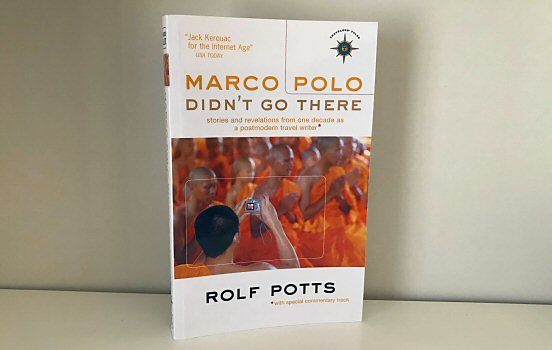
Potts has plenty of material to work with. He gets drugged and robbed in Istanbul. He attempts to crash the movie set of The Beach in Thailand. There are bad decisions, strange encounters and those wonderfully improbable moments that tend to happen when you’re far from home, slightly confused and operating without anything resembling a sensible plan.
One of my favorite chapters takes him to Australia, following in the footsteps of “The Songlines” by Bruce Chatwin. There, against considerable odds, he actually stumbles across one of the people Chatwin wrote about. Now in her nineties, she casually points out where Chatwin once sat and starts telling stories about his visit. This is exactly the kind of literary rabbit hole I find irresistible: a wannabe travel writer (me) reading an experienced travel writer (Potts) who is wandering around Australia chasing the ghost of a legendary travel writer (Chatwin).
USA Today once called Potts the “Jack Kerouac for the Internet Age”, which isn’t entirely ridiculous. His writing is witty, curious and refreshingly free of the heroic bullshit that sometimes infects travel literature. He has an adventurous streak, certainly, but also enough self-deprecation to admit when the fearless explorer is actually just some guy standing in the wrong place wondering what the hell happened.
Even the title comes from one of those moments. During an encounter in a Bangkok prison, an inmate questions Potts’ desire to follow in the footsteps of Marco Polo by traveling to Chiang Mai, as there is one small problem with this romantic notion: Marco Polo never went anywhere near Thailand.
Potts is probably still best known for “Vagabonding”, his classic 2002 manifesto on the art of long-term travel. More than a decade after publication, much of it still holds up remarkably well. Some of the material concerning the Internet inevitably feels archaeological now, written in that distant prehistoric era before smartphones, tablets and the ability to stand in a Mongolian field while arguing with Google Maps. That’s the curse of writing about technology on paper. Eventually the future arrives and makes you look quaint.
But the central idea of “Vagabonding” has aged much better. Travel doesn’t have to be a carefully packaged two-week escape from real life. With enough preparation, and perhaps a slightly unhealthy willingness to abandon comfort, routine and common sense, you can simply keep going.
And that is the dangerous thing about books like these. You start by reading about somebody else doing all this stuff. Then you look at a map. Then you check the price of a plane ticket. And suddenly staying home seems like the unreasonable option.
If you want to learn more about what Potts is up to these days, check out his blog and the interview by Tim Ferriss from last year.
Comments
No comments yet.
Leave a reply