Thailand has long been one of the great stops on the backpacker pilgrimage. People arrive by the planeload for cheap food, cheaper beer, relentless sunshine and beaches so offensively beautiful they seem designed specifically to make everyone back home hate you.
And everybody, sooner or later, starts talking about the beach. Not just a beach. The beach. The secret one. The perfect one. The little crescent of untouched paradise supposedly discovered after three buses, a fishing boat and a suspicious conversation with some guy named Klaus.
Some of this, inevitably, is the fault of Alex Garland. His 1996 debut novel The Beach became something of a sacred text among backpackers, particularly after Hollywood got hold of it four years later. The film never quite lived up to the book, but its first half did capture something recognizable about traveling through Thailand. The cheap hostels, the temporary friendships, the desperate search for authenticity and the uncomfortable suspicion that several thousand other people are searching for exactly the same thing.
Leonardo DiCaprio plays Richard, a young backpacker staying in a suitably dodgy hostel on the infamous Khao San Road in Bangkok. There he encounters an unhinged Robert Carlyle, who gives him a hand-drawn map to a supposedly secret island paradise west of Koh Samui. Naturally, Richard goes looking for it. Because apparently nobody in movies ever receives a mysterious map and says, No thanks, that sounds dangerous.
Hollywood geography is, of course, flexible. The eponymous beach was actually filmed at Maya Bay in Phi Phi Islands, while Richard’s grim Khao San Road hostel is the On On Hotel in Phuket City, about 200 meters west from where I was staying yesterday.
Travel writer Rolf Potts even tried to sneak onto the heavily guarded movie set during filming, an adventure he later described in his short story “Storming the Beach”.
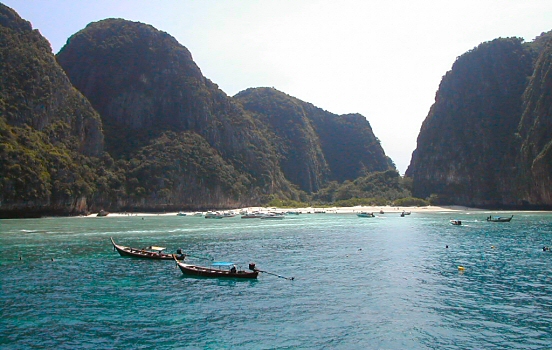 Maya Bay, as I found it.
The production team received complaints as they were altering the Phi Phi location for filming purposes. They also changed some of the hills digitally in post-production to make it even more beautiful. But it looks perfect enough to me, as I enter the bay on a boat. Maya Bay is spectacular, but it is also crowded.
This is the peculiar curse of paradise in the age of mass tourism. Somebody discovers a beautiful place. Somebody writes about it. Somebody makes a movie about it. Then everybody comes looking for the lonely beach they saw on screen, usually accompanied by several hundred other people looking for precisely the same lonely beach. Everybody is chasing a dream we’ve already seen on screen. And like all good dreams, it came with a price. We are all explorers now. We just happen to arrive on the same boat.
Ironically, Garland’s inspiration supposedly came from the lagoon El Nido on Palawan island in the Philippines, where legend also has it that he wrote the book. But geographical accuracy isn’t going to stop the faithful from descending on Phi Phi. Somewhere on this sand, after all, Leonardo DiCaprio’s backside may once have rested.
But let the relentless sun burn away the cynicism for a few moments. If I squint past the crowds and ignores the mythology manufactured by Hollywood, it really is stunningly beautiful. The limestone cliffs rise dramatically around the bay. The water is an absurd shade of blue, as though somebody has been messing with the saturation controls. The sun beats down with that merciless tropical intensity that makes jumping into the sea less a recreational activity than an urgent medical necessity.
So I do. Below the surface, small red fish move among the coral. At first they’re charming little bastards. Then they start biting me. Tiny bites, admittedly, but apparently the local wildlife has decided that Swedish tourist is today’s special. Still, as I float there looking at this ridiculous scenery, the soundtrack playing in my head isn’t “Jaws”. It’s Moby’s “Porcelain”, inevitably, from the movie.
Maya Bay isn’t the secret paradise from Garland’s novel. It probably never was. Too many boats come here. Too many cameras are pointed at the same cliffs, trying to capture the same fantasy. Sometimes paradise is crowded. Sometimes Hollywood got there first. Sometimes the fish eat you.
And sometimes, despite all that, I realize that while it may not be a perfect beach, it still is a perfect memory.

Comments
No comments yet.
Leave a reply