I’m on a train heading northeast across Sweden. It is a Sunday evening in November, the month when the Scandinavia landscape is locked in a cold blanket of gloom. I lift my eyes and have a look at my fellow passengers, their faces shrouded by quiet resignation. It’s a moving container of routine and we might as well be ferried into the gates of Hades, but everyone is stoically staring ahead. As Swedes, we know this particular dance with the darkness of winter. But also, these days I feel that traveling appears to be more routine than adventure.
People are traveling around the globe more than ever before. A lot of it can be derived to improved economies, increased living standards and the global information society. But all that is just providing a way to travel. The interesting question is why we choose to travel?
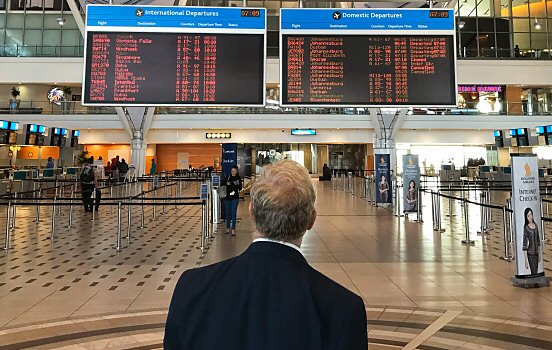 Anywhere but here.
In fact, those hard-earned money could very well be spent on far better things than traveling. All that money could feed hundreds of people instead of going into the pockets of international airlines and questionable hotel chains.
I suppose a fair bit of traveling can be attributed to a kind of rewarding luxury after spending a year at work, equal to buying stuff you desire but don’t really need. The availability of the information society is placing quite a weight on people’s shoulders. The onslaught of news channels and online mediums combine with the unyielding cell phones to make your brain constantly work in high gear. The important recreation phase of the day shrinks more and more. A temporary relief could be to move in a different direction for a while.
“It seems that the more places I see and experience, the bigger I realize the world to be. The more I become aware of, the more I realize how relatively little I know of it, how many places I have still to go, how much more there is to learn.”
— Anthony Bourdain
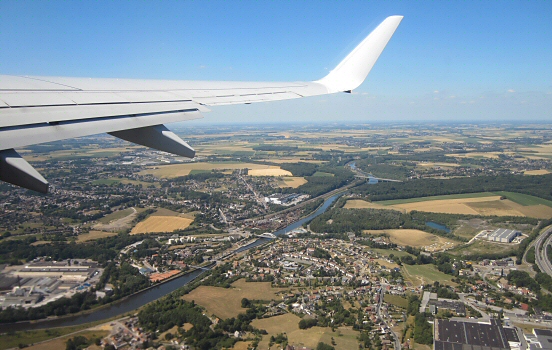 Somewhere over Belgium.
However, I think there is something more to travel. For me, the main reason for traveling is to learn about the world and better understand other cultures. To scratch the itch of curiosity. “Travel is not a reward for working, it’s education for living”, as Anthony Bourdain once put it.
It’s not about ticking boxes or collecting destinations like cheap souvenirs. It’s about breaking the rhythm. Escaping the predictable script. Stepping into a place where we don’t know how everything works, where even ordering a simple coffee becomes a minor negotiation with chaos. That’s where things get interesting.
“People who travel the world aren’t running away from life. Just the opposite. Those who break the mold, explore the world, and live on their own terms are running toward living.”
— Matthew Kepnes, Ten Years a Nomad
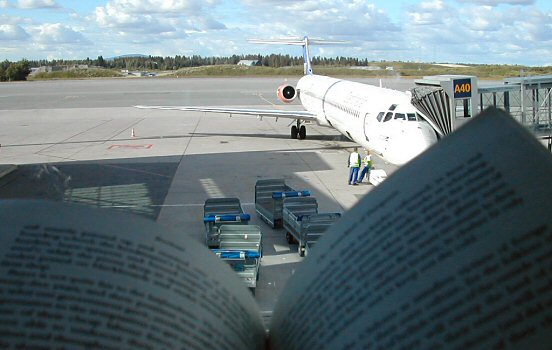 Reading Chatwin while waiting at Gardemoen, Oslo.
The need for exploration is a strong calling for some people. When George Mallory was asked why he wanted to climb Mount Everest, he simply answered “Because it’s there”.
To many, it has become an obsession. Elliott Hester sold every possession and started to travel the world. In the epilogue of Adventures of a Continental Drifter, he considers for a second to stop traveling and settle for a normal life. He immediately recoils from the idea and makes a comparison to the movie Matrix. To settle down would be like staying in the Matrix forever, when the real world awaits undiscovered on the outside.
Bruce Chatwin is another example. He often claimed that humans were essentially nomads, driven by curiosity and restlessness to discover new places. The normal state was supposed to be movement and Chatwin himself tried to embody the words of Rimbaud, “ĽHomme aux semelles de vent” (man with soles of wind). During his later years he got rid of many possessions he had earlier collected in a frenzy around the world and hunted for stories instead of objects.
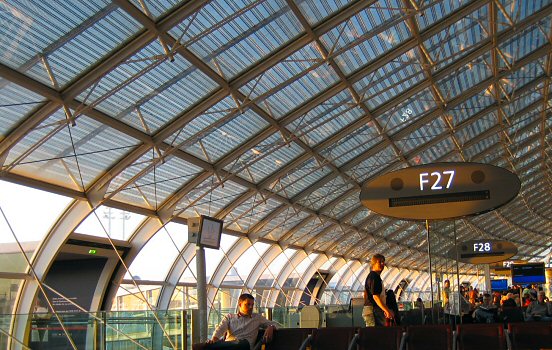 Getting stuck at CDG can make you question your life choices.
There is often an urge to move, both in terms of physical world and inner self. Nothing exciting will happen in the comfort zone. But what holds us back?
Fear of the unknown is a feeling as old as mankind itself, and few things can match the uncertainly factor that traveling provides. As such it can be an easy argument for not traveling, but I like to think of it in reverse: Use your fear to travel. Push through the veil of uncertainly and discover that there is no monster hidden behind it. As one of my all-time favorite quotes put it:
“I must not fear. Fear is the mind-killer. Fear is the little-death that brings total obliteration. I will face my fear. I will permit it to pass over me and through me. And when it has gone past I will turn the inner eye to see its path. Where the fear has gone there will be nothing. Only I will remain.”
— Frank Herbert, Dune
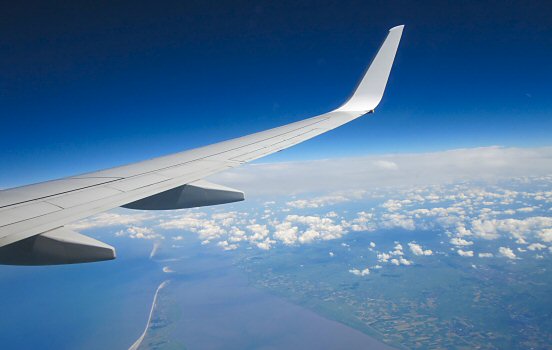 Onward to new adventures.
Meet the locals with open eyes. As humans we have much more in common than what divides us. This becomes more evident when we let go of our newspapers with gloomy headlines, and actually talk to people in other cultures.
Do ask the locals for advice, but choose wisely. I guarantee that the young clerk at the hostel has a lot more useful knowledge of what good stuff to eat in the town than the well-dressed receptionist at the upscale hotel. Unless you’re actively looking for the polite safe-but-dull tips like “try the Oyster Bar in Grand Central Station” or “look for sea food at Fisherman’s Wharf”.
Of course, sometimes it sucks. You get scammed at the local market. You eat something questionable that seemed like a good idea at the time. You miss that bus and sit in a plastic chair at 2 AM wondering why you thought this was a smart plan.
But even that beats the hell out of the alternative. Because those moments are the ones that stick. They’re the stories you carry with you. The scars you’re oddly proud of. The proof that you stepped outside the bubble and survived.
If things don’t go according to plan on your travels, just remember that it’s all about the journey, not the destination. It’s a good thing to once again be reminded that you are still learning about the world.
Why do we travel? I think the answer to the question is too complex to describe in a few words, and there are probably just as many answers as there are people in the world. Me? I’m off to see the wizard.
2 comments
Leave a reply