Three years is a long time to go without a festival. The last Way Out West was back in 2019, a soggy affair with more rain than memorable bands, at least according to this increasingly grumpy attendee. Then came the pandemic, and suddenly standing shoulder to shoulder with twenty-five thousand strangers became a distant memory from another lifetime.
Now everyone was back. The sun apparently decided to make up for lost time. Slottsskogen baked under relentless heat, and nowhere had it worse than the Linné tent, which quickly transformed into something between a greenhouse and a survival exercise. People were fainting before the first day had properly found its rhythm.
Then came Kite. Half of Gothenburg seemed determined to squeeze into the tent to witness the reigning wizards of dramatic synthpop. The result resembled a slow-motion meat grinder, humid and alarmingly overcrowded. At some point I stopped thinking about the music and started wondering whether the organizers had ever considered the revolutionary concept of ventilation. The Linné stage has become a victim of its own popularity, and in its current form it borders on unsafe.
Musically, the festival seemed oddly obsessed with British rap. A genre that has never managed to win me over, to put it mildly. Fortunately, Way Out West has always been about more than whatever happens on the stages. It’s overpriced food, strange paths through Slottsskogen, sunburned faces, endless queues and the unmistakable feeling that an entire city had collectively decided life was worth celebrating again after the long, strange years of Covid.
Among the fashionable crowd I spotted something far more interesting than the latest sneakers: not one but two Einstürzende Neubauten T-shirts. That may not sound remarkable, but in nine visits to Way Out West I think I’ve seen exactly three Neubauten shirts in total, one of them being my own. Perhaps Blixa Bargeld’s long association with Nick Cave has created a few new converts. Whatever the explanation, it felt like finding distant relatives in a foreign country.
The lineup delivered its usual beautifully confused mix. Arab Strap were still gloriously Scottish and gloriously miserable. Beabadoobee turned out to possess far more energy than expected. But if I’m honest, all bands were merely the opening act for the only performance that truly mattered. Nick Cave & The Bad Seeds.
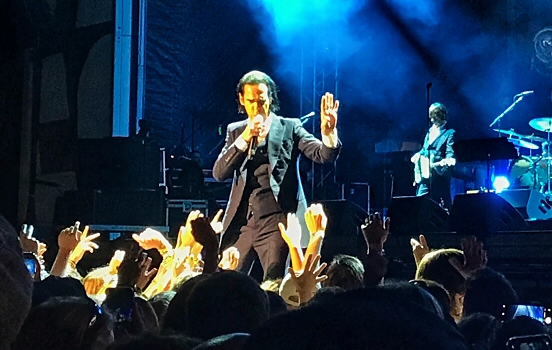 Nick Cave preaching to the crowd.
The last time I saw Cave was in 2008, fronting the gloriously unhinged Grinderman. Fourteen years later he returned with the full Bad Seeds ensemble (minus Blixa of course), and age has done nothing to diminish his presence. If anything, it has sharpened it.
Once nicknamed the “Evil Jesus of Melbourne,” Cave is now sixty-five, carrying the kind of grief that permanently alters a person’s voice. The tragedies of the past decade have seeped into his songs without making them smaller. If anything, they’ve made them monumental.
“And I don’t believe in the existence of angels
But looking at you I wonder if that’s true
But if I did, I would summon them together
And ask them to watch over you”
— Nick Cave, Into My Arms (1997)
Watching him perform is less like attending a rock concert and more like sitting through an ecstatic sermon delivered by a preacher who has seen heaven, hell and several places in between. One moment he whispers like a man sharing a secret. The next he commands the entire audience with the conviction of someone who knows exactly where every heartbeat in the park is hiding.
The setlist stretched from From Her to Eternity (1984) all the way to Ghosteen (2019), four decades of music tied together by one extraordinary performer who somehow continues to evolve instead of becoming a museum piece. There are very few artists left in the world who can make twenty-five thousand people feel like they’re gathered in a single room. Nick Cave remains one of them.
Comments
No comments yet.
Leave a reply