Alex Garland’s debut novel “The Beach”, published in 1996, was once practically mandatory equipment for backpackers. You saw battered copies everywhere in hostel common rooms, beach cafés, airport floors, wedged between a Lonely Planet and somebody’s increasingly questionable underwear.
Yes, the movie adaptation certainly helped. Leonardo DiCaprio plays Richard, a young backpacker who arrives in Thailand looking for something better than the usual tourist conveyor belt. The film never quite lives up to the book, but its first half gets something very right. It captures the intoxicating freedom of backpacking around Southeast Asia at the turn of the millennium, helped considerably by a soundtrack featuring Moby and enough late-1990s atmosphere to make you start looking for your old cargo shorts.
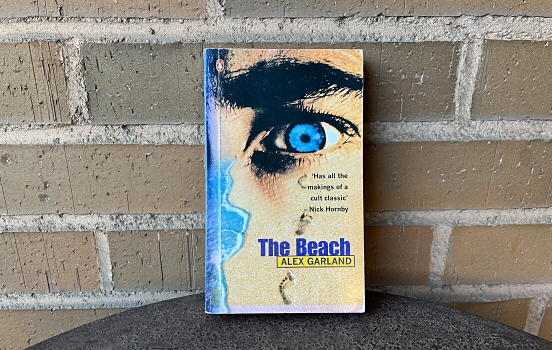
Back then, Thailand felt like the center of the backpacking universe. A universe with cheap drinks, ornate temples, pristine beaches and the same collection of Westerners you could have met without leaving home. These were the supposedly good old days before smartphones social media. Many of us, myself included, embraced what travel writer Rolf Potts called “full-on dirtbag travel mode”. Roaming from place to place on overcrowded buses, questionable ferries and the open backs of pickup trucks, carrying a filthy backpack containing everything you supposedly needed to survive.
It was uncomfortable. Occasionally stupid. Frequently wonderful. And, of course, we all wanted to find somewhere nobody else had found. That is the central joke, and tragedy, of “The Beach”. Richard hears about a secret island inhabited by a small community of travelers who have somehow escaped mass tourism. Paradise, apparently, exists. The only problem is that paradise depends entirely on nobody telling anybody else about it. As Garland writes:
“There’s no way you can keep it out of the Lonely Planet, and once that happens, it’s countdown to doomsday.”
— Alex Garland, The Beach (1996)
The novel begins with the familiar romantic delusions of the young traveler and gradually becomes something much darker. Paradise develops rules. The friendly little community becomes tribal. People behave badly. Things go seriously wrong beneath the palm trees, resembling a pop culture version of the 1954 classic Lord of the Flies.
What makes the book interesting is not really the beach itself, but the hypocrisy surrounding it. Western travelers arrive in another country claiming to reject conventional tourism, while bringing their own assumptions, cultural values and imported neuroses along for the ride. Everyone wants an “authentic” experience, preferably one conveniently arranged around their own expectations. And there is the uncomfortable truth at the center of the whole thing: the search for the perfect untouched place is often precisely what destroys it.
The irony became spectacularly complete after the novel and movie made millions of people want to find their beach. Maya Bay on Phi Phi Leh, used as the principal location for the film, became an attraction in its own right. People arrived in boats, carrying cameras, sunscreen and dreams of Leonardo DiCaprio emerging mysteriously from the jungle.
I visited Maya Bay in 2003. It was beautiful. It was also no longer a secret. In that sense, The Beach became a self-fulfilling prophecy. A story warning about travelers destroying paradise helped send armies of travelers looking for exactly that paradise. The hordes heavily contributed to the pollution and destruction of the coral reefs in the area. There is something almost perfect about that cruel irony.
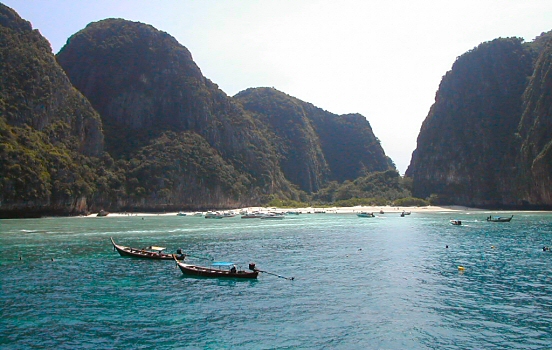 Maya Bay, as I found it in 2003.
Reading the novel today, parts of it are very obviously trapped in the 1990s. The characters can feel thin, and future generations may find some of its cultural references as mysterious as fax machines and internet cafés. But the central idea has aged disturbingly well. Travelers still want to believe there is another beach, another village, another bar down some badly lit alley that nobody else knows about. Somewhere authentic. Somewhere untouched. Somewhere we can briefly possess before everybody else turns up.
And when we finally find it? Naturally, we tell everyone.
Comments
No comments yet.
Leave a reply