Today Henry Rollins turns 60. Outside it’s cold, grey and generally hostile to human activity, which seems like an entirely appropriate setting for spending a Saturday indoors with Henry.
I’ve read several of his books, watched an unhealthy number of his shows on DVD and seen him perform live four times. Rollins can make almost anything entertaining: punk rock, politics, airports, bad coffee, the decline of civilization. But I’ve always liked him best when he talks about travel.
Not comfortable travel. Not infinity pools, complimentary prosecco and carefully staged sunsets. Rollins travels like a man who has been given a passport, a backpack and a vague suspicion that something interesting might happen if he keeps moving.
Many of his books are assembled from journals, each entry stamped with a date and location like evidence collected at a crime scene. The habit goes all the way back to his years touring with Black Flag, when he scribbled observations from the road. Those notes eventually became photocopied, folded and stapled pages, then books, and eventually a small library documenting several decades of one very restless man refusing to sit still.
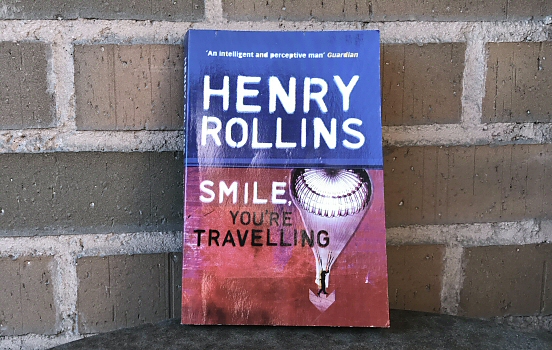
“Smile, You’re Traveling” is the third book in the Black Coffee Blues trilogy and collects journal entries from 1997–1998. Part travelogue, part tour diary and part extended argument between Henry Rollins and Henry Rollins, it moves constantly between observations of the outside world and whatever storm happens to be raging inside his head.
Several chapters follow his first journey through Africa. He travels through Kenya and Madagascar, fascinated by the wildlife and considerably less impressed by the humans wandering around it. This is classic Rollins territory: put him in front of some magnificent animals and he becomes almost sentimental. Add a few tourists and the misanthropy quickly returns.
Elsewhere he walks the frozen streets of Moscow, grows tired of hotel television in Tel Aviv, inhales the industrial bouquet of Cairo, struggles to comprehend the relentless politeness of Tokyo and finds new reasons to complain about radio stations in Sydney.
Then it’s back on the road. City. Airport. Hotel. Venue. Soundcheck. Show. Repeat. The weariness sometimes drips straight from the paper.
Large sections of the book are a blur of tour dates across Europe and the United States, with Rollins observing each destination through the eyes of someone who spends far too much time alone in unfamiliar places.
Sweden does not escape unharmed. He admits that he has “never been a big fan of the place” and describes the security guards in Stockholm as possessing something resembling “glacial privacy”. As a Swede, I’m not entirely sure this is criticism. It sounds more like a reasonably accurate field report.
Despite his Black Flag history, Rollins isn’t always recognized, although he rarely manages to disappear into the scenery. Locals become curious about this muscular, tattooed American wandering around alone and eventually ask the obvious question: “why are you here?”. His standard answer is wonderfully simple: “I’m here to meet you”. Probably not what they expected.
That attitude is what makes his travel stories work. Rollins isn’t particularly interested in luxury, bucket lists or collecting famous landmarks. He travels because he wants to see what is there. People. Streets. Animals. Strange conversations. Bad hotels. Good record stores. Whatever happens. I read an interview where Henry said “I just travel the world with my backpack and my cameras and a bunch of Clif bars”, which is a refreshing thought in these days when influencers only travel to Instagram-worthy locations.
There’s naturally plenty of music trivia along the way. He spends time with Black Sabbath, takes swings at MTV culture and at one point considers the important geopolitical question of who would win a fight between Sheryl Crow and Bruce Lee.
These are the issues travel literature too often neglects. But this isn’t simply a collection of funny stories about strange places. The journal format means there is nowhere for Rollins to hide, and his train of thoughts frequently accelerate from amusing observation into much darker territory. Loneliness appears often. So does alienation, anger and self-doubt. The feeling of being permanently outside the room looking in.
One moment he is fascinated by some absurd detail of life on the other side of the planet. A few pages later he is digging through the basement of his own psyche with a flashlight and apparently no intention of coming back upstairs anytime soon.
It can be exhausting. It can also be brutally compelling. That tension is probably what makes the book interesting. Rollins travels halfway around the world, but he can never escape the most difficult traveling companion of them all: himself. And perhaps that is why his stories still resonate. The best travel writing isn’t really about where someone went. It is about what happened when they got there, and whether they came back seeing the world, or themselves, a little differently.
If you enjoy the travel side of Henry Rollins, I’d also recommend Get in the Van (1994), the considerably rougher account of his Black Flag years on the road, and Occupants (2011), which combines his photography with observations gathered from years of wandering around the planet. Preferably with a backpack, a camera and very little interest in staying at the resort.
Comments
No comments yet.
Leave a reply