The @media conference, officially renamed Web Directions, used to be one of the great pilgrimages for web developers. Once a year the tribe gathered in London, swapping arguments and war stories while the generals of the web standards movement confirmed their positions in the ongoing crusade. Back in 2006, my colleague Roger Johansson of 456 Berea Street was one of the speakers. Five years later, the battlefield looks very different.
Many of the veterans are still around. Andy Clarke, Bruce Lawson and Jeremy Keith are still here, now joined by a younger generation who has grown up in a world where standards aren’t as much a revolution anymore but simply the way things are done. The war is almost over since most vendors embrace web standards today. Even Microsoft has started showing signs of repentance with Internet Explorer 9, arriving fashionably late to the standards party but at least bringing a bottle of wine.
This means that the brilliant minds can focus on other stuff. With fewer battles to fight, the question becomes: what should we focus on now? The answer on the conference floor, unsurprisingly, is HTML5, CSS3 and mobile development. The future has shrunk to something you carry in your pocket.
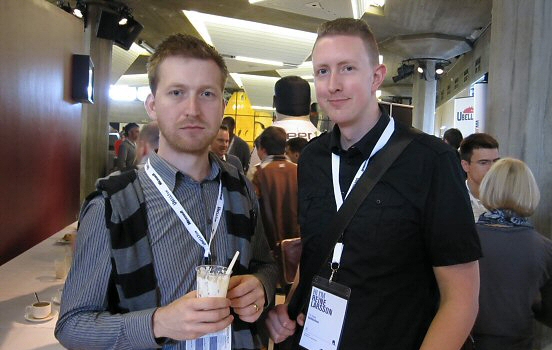 Roaming the Queen Elizabeth Hall.
We kicked things off with a full-day workshop on mobile applications led by Jonathan Stark. There are divided opinions on whether to do pure native apps or go for web apps. We settled somewhere in the middle with hybrid apps, essentially web files wrapped inside a native executable. It’s an engineer’s compromise, which usually means nobody gets everything they want but everybody gets enough.
Naturally, there is a little black magic involved. One of the most popular tools is PhoneGap, an open source native app wrapper which enables support for native hardware features such as camera and accelerator. The catch? Building for iPhone means bowing before the altar of Xcode and, by extension, owning a Mac. Fortunately there are already cloud services willing to compile the code remotely, sparing Windows developers from having to explain to accounting why they suddenly needed shiny aluminium laptops.
We also looked at libraries such as JQTouch, which can ould make ordinary markup feel surprisingly native with a bit of styling. There are also many learnings about designing for fingers instead of mice, probably a difficult adjustment for people who had spent years obsessing over pixel-perfect hover states.
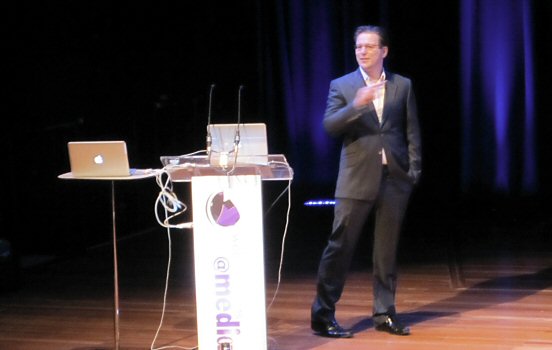 Andy Clarke holding keynote.
Tom Coates opened the conference with one of those talks that makes you briefly forget your inbox exists. He reminded us that the first HTML page appeared in 1991. Barely twenty years later, Google has indexed some 28 billion pages and digitized millions of books. Almost everything we casually call “the modern internet” has appeared within this decade, as the nineties had a very modest internet population compared to today.
As he put it: “All this magic has been happening in the last 10 years, and you’re all part of changing the world.” It can be easy to scoff at grand statements like that, until you realize he’s right. Ten years ago there was no Facebook, no YouTube, no Twitter, no endless social feeds demanding your attention.
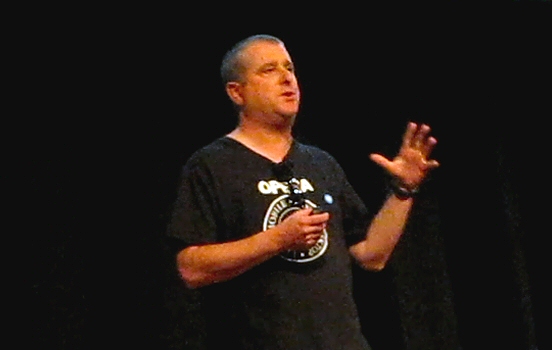 The awesome Bruce Lawson (without viking helmet).
Bruce Lawson delivered one of the conference highlights with a deep dive into HTML5 video. Suddenly video can be part of the document itself rather than hidden inside mysterious browser plugins. The new <video> element is native and thus accessible by keyboard as well as controllable by JavaScript and CSS. The <track> element and vtt-files (Web Video Text Tracks) can be used for accessible subtitles. You can also use media queries to send low resolution video to mobile units.
Of course, browser vendors cannot agree on video codecs any more than children can agree on pizza toppings. The different browsers have varying support for formats such as mp4/H.264, WebM and Ogg/Theora, forcing developers to ship multiple versions of the same video and hope for the best. Progress, as always, arrives dragging a sack full of compatibility hacks behind it.
Douglas Crockford, legendary creator of JSON and one of JavaScript’s patron saints, started by discussing clever JavaScript techniques before gradually transforming the session into an extended roast of Internet Explorer. The audience seemed perfectly happy to follow him there.
Lea Verou demonstrated CSS3 gradients with enough elegance to make them seem almost magical. Linear, radial, you name it. Have a look at her gradient demos and view the code if you’re brave enough.
Addy Osmani fired JQuery framework links at the audience with machine-gun efficiency, where I think Modernizr is one of the most useful.
Jeremy Keith wrapped up the first day with a lively panel featuring Bruce Lawson, Douglas Crockford, Brian Suda and Relly Annett-Baker, proving that putting smart people on a stage together is still one of the simplest forms of entertainment.
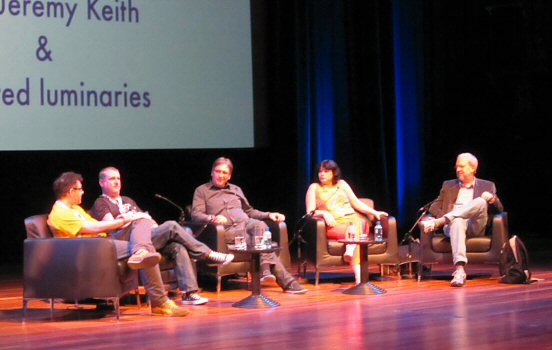 Brian Suda, Bruce Lawson, Jeremy Keith, Relly Annett-Baker and Douglas Crockford.
Day two opened with a keynote by Andy Clarke, who demonstrated the free tool Animatable by recreating the Mad Men title sequence entirely with CSS3 transforms, transitions and animations.
Michael Mahemoff explored offline web applications through local storage, session storage, WebSQL database and the application cache. Technologies that hint at a future where web apps can behave less like disposable documents and more like real software.
Nicole Sullivan delivered practical advice on squeezing every ounce of performance from CSS3. A good point is that browsers read selectors from right to left, so “div.classname” is slower than “.classname”. Other things to avoid are box-shadow, rgba-transparency and the attr-selector.
Dave Bulmer closed the schedule with an energetic session on HTML5 graphics, comparing Canvas and CSS3 while boldly predicting that SVG might eventually fade into history.
But as with every good conference, the talks are only half the story. The real value happens in the hallways, over coffee, during lunch or while waiting for the next session to begin. A five-minute conversation with someone wrestling with the same problems as you can be worth more than fifty presentation slides. Technology changes with alarming speed. Those conversations, exchange of ideas, bad jokes and hard-earned lessons are the part that tends to survive long after the frameworks have become obsolete.
Comments
No comments yet.
Leave a reply