30 years is a very long time. Long enough for technologies to be born, conquer the world, become deeply unfashionable, get rediscovered by hipsters and eventually return as retro-something.
Think back in time. Preferably in the voice of Connor MacLeod from Highlander.
1994 was an interesting year. Berlin’s long Allied occupation formally ended. Kurt Cobain was found dead. The Channel Tunnel opened, finally allowing the British and French to insult each other without involving a ferry. Quentin Tarantino released his second film Pulp Fiction. Nelson Mandela became president of South Africa. Jeff Bezos started a little company called Amazon. Nine Inch Nails released The Downward Spiral. The first PlayStation by Sony was released.
And somewhere among these minor historical distractions, Mink Machine appeared. One evening I sat down in front of a Solaris workstation, opened Emacs and started writing HTML by hand. No content management system. No JavaScript framework. No package manager downloading 800 megabytes of dependencies so you can display a button. Just markup, stubbornness and the vague suspicion that this Internet thing might be interesting. I had absolutely no idea what I was getting myself into.
 Writing on my book surrounded by Basque pintxos.
In 1994 there were only a few thousand websites in existence. Netscape Navigator had just arrived, bringing the revolutionary concept of looking at the web without requiring the beard of a Unix administrator. Internet Explorer was still a year away.
This was 4 years before Google was started and 9 years before Git was invented. There was no Facebook, Instagram, Reddit, Stack Overflow or any of the things that modern developers and creators take for granted.
If you had a problem, you couldn’t simply paste an error message into Google and discover that some exhausted developer in London had solved exactly the same problem eleven years earlier. You had documentation. Maybe a book. Possibly a colleague. Good luck.
There were no smartphones, Wi-Fi networks or flat-screen monitors. A 14.4 kbps modem was considered perfectly respectable technology, despite sounding like a robot being slowly murdered whenever it connected. Downloading a single image could take a minute. Naturally, we put large images on websites anyway. We were young. Bandwidth was somebody else’s problem.
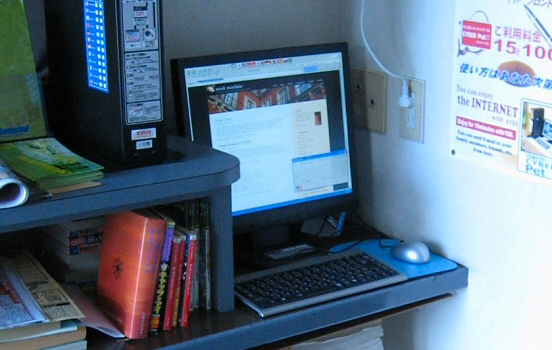 Writing a blog post somewhere in Hiroshima, Japan.
And somehow, against all reasonable expectations, we arrived here. The web became a gloriously complicated industrial complex of streaming video, social networks, surveillance capitalism, cookie banners, walled gardens, cloud platforms and JavaScript frameworks created specifically to replace the JavaScript framework everybody was using eighteen months ago.
A web page that once consisted of a few kilobytes of HTML can now require several megabytes of scripts, twelve external APIs, three consent dialogs and a package dependency maintained by one mysterious developer in Liechtenstein.
But underneath all that machinery, something remains remarkably familiar. There was magic to be found in 1994, and despite three decades of corporations, algorithms, SEO consultants and people insisting that everything needs to become a vertical video, some of that magic is still there.
Mink Machine has survived browsers, platforms, redesigns, dead links, questionable HTML, forgotten technologies and thirty years of me finding new places to visit, things to photograph and airlines to complain about. Apparently, I’m not finished yet. So I’ll keep lurking around this increasingly strange corner of the Internet for a while longer.
And to everyone who stopped by sometime during these three decades, whether you’ve been here since the modem screamed at you or arrived five minutes ago on your smartphone, thanks for tuning in.
Comments
No comments yet.
Leave a reply