After Anthony Bourdain died in 2018, the books inevitably followed. Biographies, histories, travel guides. Everyone trying, in one way or another, to reconstruct the man from the wreckage, and make a profit along the way.
His longtime assistant Laurie Woolever published “Bourdain: The Definitive Oral Biography” in 2021, assembling the memories of friends, family and colleagues into a chronological portrait. The same year came “World Travel: An Irreverent Guide”, originally intended as a collaboration with Bourdain himself. It’s a handsome enough book, and useful when you need to remember where Tony ate noodles in Hanoi or drank something dangerous in Seoul, but anyone who has obsessively watched the television shows will find themselves on familiar ground. I mostly keep it around as a geographical Bourdain encyclopedia.
Then came Charles Leerhsen’s unauthorized biography “Down and Out in Paradise”. It caused controversy, and not without reason. There are fascinating details buried in there, but the book has the uncomfortable atmosphere of somebody going through a dead man’s drawers after the funeral guests have gone home. Leerhsen seems particularly determined to connect every available dot to Bourdain’s suicide. Sometimes a miserable afternoon is just a miserable afternoon.
Interesting books, certainly. But they mostly examine Bourdain himself. Tom Vitale’s “In the Weeds” from 2021 does something much more interesting: it examines what happened around him.
Vitale spent more than a decade directing and producing No Reservations and Parts Unknown. He was there for the long flights, disastrous shoots, logistical nightmares, heated arguments, drinking sessions and those strange moments when a television crew finds itself somewhere far from home wondering exactly how everything went so spectacularly wrong. And that is where the good stuff is.
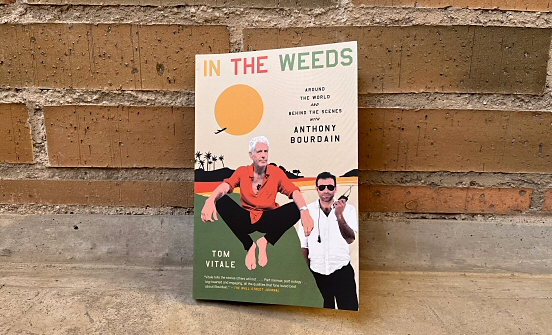
“In the Weeds” is frequently hilarious, occasionally horrifying and surprisingly moving. Vitale clearly loved Bourdain. He also, at times, clearly wanted to strangle him. Both things can be true.
This is not another polished portrait of the charismatic traveler wandering through a night market, beer in hand, delivering perfectly constructed observations about life, death and grilled animal parts. Vitale takes us behind the camera. We see the machinery required to create those apparently spontaneous moments. Exhausted crews, missed flights, bad decisions, impossible demands placed upon the inner circle, and the peculiar gravitational field surrounding Bourdain himself.
Much like Rolf Potts pulling apart the machinery of his own travel stories in the notes to Marco Polo Didn’t Go There, Vitale shows us what happened between the takes, after somebody yelled cut and before television transformed chaos into something beautiful. That makes In the Weeds perhaps the most revealing Bourdain book written by somebody other than Bourdain.
There is warmth here, but very little hero worship. Vitale remembers a brilliant, funny, generous man who could also be difficult, unpredictable and exhausting. The contradictions aren’t inconvenient details to be edited out. They are the story. If No Reservations and Parts Unknown showed us the finished meal, “In the Weeds” takes us through the swinging doors into the kitchen. And, as usual, the kitchen is where things get interesting.
Comments
No comments yet.
Leave a reply