After a tedious train ride, I finally arrived in Esztergom. Once the capital of Hungary, Esztergom has since settled into a quieter existence. Empires rise, capitals move on, and eventually someone opens a souvenir shop.
I walked through town toward the hill overlooking the Danube, crowned by Esztergom Castle and the enormous basilica beside it. The basilica is the largest church in Hungary, which means subtlety was clearly not part of the architectural brief. It dominates the skyline with the confidence of an institution that knows exactly where it stands in the cosmic hierarchy.
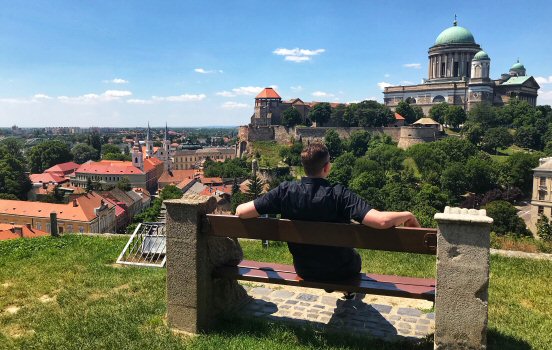 Talking a short rest before ascending the hill to Esztergom basilica.
Below it lies the crypt, filled with tombs and blessedly cold air. Outside, Hungary was being slowly roasted by the summer sun. Down here among the dead, the temperature was perfect. Sometimes the deceased really do get the better accommodation.
Eventually I climbed back into daylight and stood on the great stone wall overlooking the Danube. Below, the river shimmered in the heat, separating Hungary from Slovakia with the casual indifference of geography. Except of course, there was a bridge.
The Mária Valéria Bridge stretches across the Danube, connecting Esztergom with the Slovak town of Štúrovo since 1895. And once you see a bridge leading into another country, there is really only one sensible thing to do. Walk across it. An hour later, that’s exactly what I was doing.
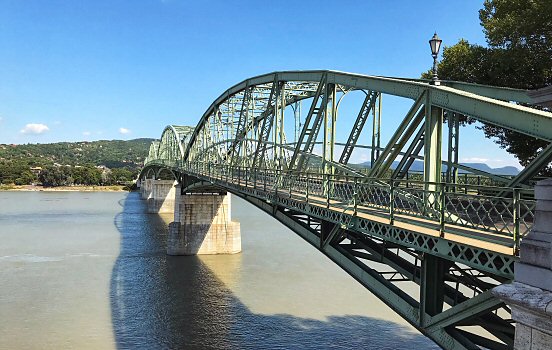 Mária Valéria bridge.
There was no dramatic border crossing. No barbed wire. No grim-faced guards demanding papers. No checkpoint where someone with a large moustache examines your passport as though personally offended by it. Just a bridge, a sign and the wind blowing lazily across the Danube. A few minutes later, without ceremony, I was in Slovakia.
Štúrovo does not immediately overwhelm the visitor with its magnificence. I wandered past a few closed shops, quiet streets and a statue of Ján III Sobieski. This was not Paris. Nobody was going to write a sonnet about the place. But then I found an open bar. And there, waiting at the end of my completely unnecessary international expedition, was an ice-cold pint of Zlatý Bažant.
I hadn’t walked to Slovakia because there was something spectacular waiting on the other side. There was no essential landmark to photograph, no bucket-list box demanding a triumphant tick. I walked across because I could.
There is something deeply satisfying about crossing an international border on foot. One moment you’re in Hungary. A few hundred meters later you’re in Slovakia. No airport security, no boarding passes, no luggage carousel slowly rotating without your bag. Just your own two feet and a bridge across a river.
Borders in Europe once had teeth. Here today, this one barely whispers. You simply walk across. And suddenly the world feels just a little bigger and considerably more civilized.
Comments
No comments yet.
Leave a reply