The city of Genoa has always had a peculiar pull on travelers. Not the polished kind of beauty that smiles for postcards, but something rougher around the edges. Something that feels earned.
I walk alone through the narrow arteries of the old town, the Caruggi. They say this historic center is the largest in Europe, and after a few minutes inside it, I stop thinking of it as a city and start thinking of it as a living organism.
Plenty of places brag about having maze-like streets. Genoa actually delivers. The alleys twist and knot together like the headphone cords I used to keep in my pocket, back when people still carried wired headphones and accepted chaos as part of life. This is a dark labyrinth of shady alleys, where strange individuals sit scattered in corners, watching my every step. A faint smell of weed mixed with fresh Focaccia fills the air. There is a certain level of beautiful decay here, the kind that reminds me of Le Panier in Marseille. I feel like I should keep my wallet close and my curiosity even closer.
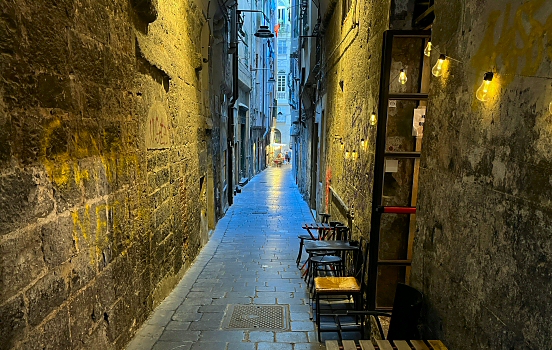 Yet another deserted alley.
Then suddenly, as if someone opened a curtain, light spills in again.I pass beneath the towers of Porta Soprana, the old gate that has somehow survived the centuries while kingdoms, rulers and ambitions came and went around it. I leave the medieval quarters behind, and the city changes almost instantly. The air feels lighter and the streets breathe differently.
I stand in front of what is called the House of Christopher Columbus. The explorer was born in Genua 1451 and supposedly lived here between ages 4-14. The building itself is largely a reconstruction, rebuilt on the original site after wars and centuries had their say. But details like that rarely matter to travelers. Standing there, it is easy enough to imagine a restless kid staring toward the harbor, toward ships disappearing into horizons that at the time still felt infinite.
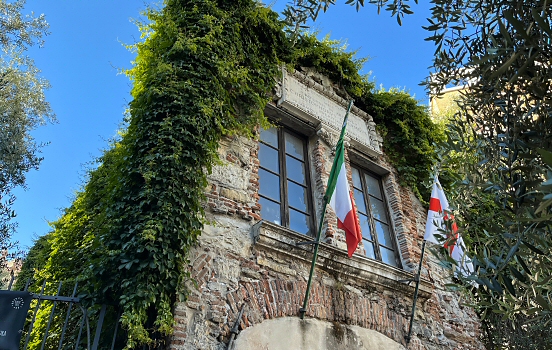 House of Christopher Columbus.
continue down toward the old port, Porto Antico, and stand in front of another legendary building. Palazzo San Giorgio is covered with faded murals, and according to the stories, this was once the prison that held Marco Polo in 1296-99. Legend says he passed the time telling stories of distant lands to a fellow prisoner, who wrote them down and eventually turned them into one of history’s great travel accounts.
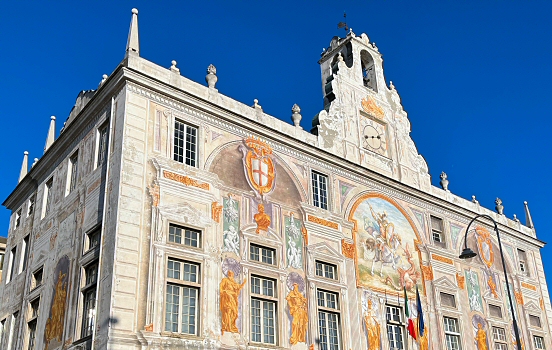 Palazzo San Giorgio.
But Genoa has a habit of playing tricks on you. Not everything that looks ancient actually is. Further along the harbor I suddenly come face to face with “Il Galeone Neptune”, a large pirate ship that looks like it sailed straight out of the fever dreams of Jack Sparrow after too much rum. But it was actually built in 1985 for Roman Polanski’s film “Pirates”, and later reappeared as Captain Hook’s ship in the 2011 TV series “Neverland”. It may not fit the mold to be an ancient artifact, but it certainly looks the part.
I inevitably drift back into the dark alleys and sit down with a plate of pesto, Liguria’s most famous gift to the world. Time moves strangely in cities like this. Centuries collapse into each other. Empires rise and disappear. But some truths remain constant. There is always time for a good meal.

Comments
No comments yet.
Leave a reply