Usually, travel stories involve a person going somewhere. Preferably somewhere inconvenient, slightly dangerous, and with questionable plumbing. In The Map of Knowledge by Violet Moller, however, the travelers are ideas.
This isn’t a travel book in the conventional sense. Nobody misses a train, gets food poisoning or wakes up in a cheap hotel wondering where their passport went. Instead, Moller follows knowledge itself as it makes the long, improbable journey through centuries of war, religious upheaval, collapsing empires and humanity’s recurring enthusiasm for destroying things it doesn’t understand.
After the western Roman Empire fell apart, Europe became something of an intellectual scrapyard. Cities declined, institutions disappeared and manuscripts containing centuries of accumulated knowledge were lost, neglected or deliberately destroyed. Christianity wasn’t always terribly enthusiastic about preserving pagan science either. Yet through stubborn scholars, translators, collectors, librarians and the occasional stroke of dumb luck, some of those ancient texts survived.
Moller chooses three works in particular, by Euclid, Ptolemy and Galen, and follows their journeys across the world. And quite a journey it is.
The manuscripts travel east, eventually reaching Baghdad, where scholars translated, studied and expanded upon the ancient Greek knowledge. At a time when much of western Europe was busy with the traditional medieval hobbies of warfare, disease and arguing about God, Baghdad was one of the great intellectual centers of the world.
From there, copies and translations moved west again, eventually reaching Muslim Spain. Córdoba and Toledo became remarkable centers of scholarship where Greek, Arabic, Jewish and Christian intellectual traditions collided, mixed and occasionally managed not to kill each other.
Then the trail moves to Sicily, another cultural crossroads where Greeks, Arabs, Normans and assorted conquerors had all left fingerprints on the place. Palermo and Syracuse become further stops on this strange relay race through history.
Finally, we arrive in Venice. By then, Gutenberg’s invention had changed the rules. Knowledge no longer had to depend entirely on some exhausted monk spending half his life copying a manuscript by candlelight. Printing allowed these ancient works to multiply, spread and survive into the Renaissance and beyond.
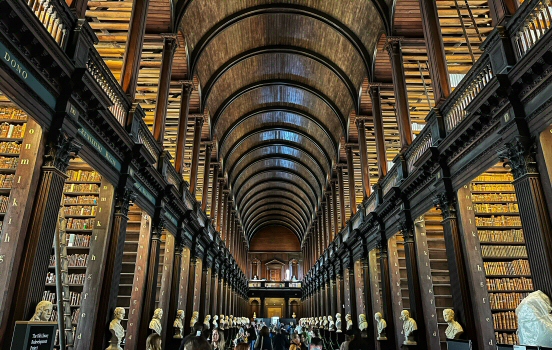 The impressive Long Room library at Trinity College, Dublin.
This is ultimately a story about unsung heroes: translators, scholars, scribes and forgotten intellectuals whose names rarely appear outside academic footnotes. They didn’t conquer kingdoms or command armies. They did something arguably more useful: they kept ideas alive. Thanks to them, we can still read works written thousands of years ago even though the original manuscripts themselves have long since disappeared. There is something wonderfully fragile about that.
Civilizations collapse. Libraries burn. Religions change. Empires come and go with impressive confidence and usually leave behind a mess for someone else to clean up. Yet a battered manuscript gets copied in Baghdad, translated in Toledo, carried through Sicily and eventually printed in Venice. And somehow the idea survives.
That said, The Map of Knowledge isn’t exactly Indiana Jones. Much like Andy Weir’s The Martian sometimes feels like a science textbook that has kidnapped an adventure novel and stolen its clothes, The Map of Knowledge occasionally feels like a chronological history textbook wearing a travel hat. It can be the sort of dry where you start thinking fondly about footnotes.
But the central idea is fascinating, and Moller provides an excellent overview of how knowledge survives. Not through some inevitable march of progress, but because particular people, in particular places, decided that certain ideas were worth saving.
And as a traveler, there’s another reason to read it. Baghdad, Córdoba, Toledo, Palermo, Syracuse and Venice stop being merely collections of monuments, churches and restaurants competing for your limited attention. You begin to see them as nodes in an ancient network, places where ideas arrived, were translated, argued over, improved, copied and sent onward.
So The Map of Knowledge isn’t a particularly thrilling travel book. But read it before visiting some of these cities and you may find yourself looking at them differently. Which, when you think about it, is one of the better reasons to read a travel book in the first place.
Comments
No comments yet.
Leave a reply