Gothenburg has become a frozen wasteland. The temperature has been below freezing for weeks, the river is turning to ice and the ghost of Covid-19 continues to hang over the city like an unwelcome houseguest who has overstayed his welcome, emptied the liquor cabinet, and shows no intention of leaving.
Back in autumn last year, as the days grew shorter and the dreaded “second wave” came crashing ashore, there were still signs of civilization. People wandered the streets, friends gathered in restaurants, and a few stubborn souls could be found propping up the bars, presumably determined to drink their way through the apocalypse. But since the turn of the year, Gothenburg has been steadily emptying out. The streets are deserted, the restaurants silent and the city feels like the opening scene of a particularly depressing zombie movie.
And this is Sweden, mind you. A country whose pandemic restrictions have been comparatively relaxed. Then again, social distancing has always been something of a national pastime. The old meme about “waiting for the bus like a Swede” several meters apart has suddenly become official public health advice. We’ve been training for this our entire lives.
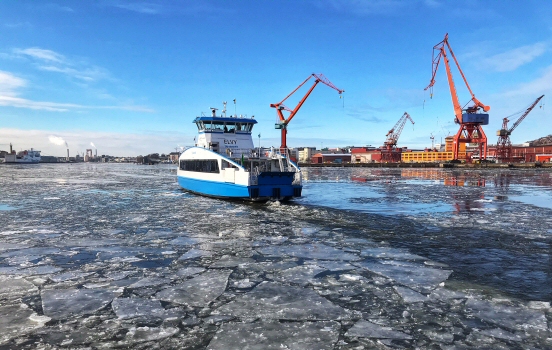 Local ferry westbound across the ice.
The other day, walking along the harbor, I watched one of the familiar local ferries making its way across the river. I’ve seen these boats countless times over the decades, barely giving them a second thought. But this time something was different.
The little vessel was cutting a slow, deliberate path through sheets of floating ice, stubbornly pushing forward through the frozen river. There was something strangely moving about it. A battered little symbol of persistence, ferrying its passengers through the cold toward whatever waited on the other side. A maritime version of Snowpiercer, minus the class warfare and cannibalism. At least, one hopes.
Perhaps isolation does strange things to the mind. Spend enough time staring at the same four walls and even a commuter ferry starts looking like a profound metaphor for the human condition.
But history has a nasty habit of reminding us that the world is never particularly stable. The late 1980s brought the collapse of the Soviet Union and a geopolitical reshuffling that nobody quite knew what to do with. In 2001, terrorists flew planes into the World Trade Center and the world changed overnight. Then came the financial crisis, when the global economy nearly disappeared down the toilet, courtesy of people wearing expensive suits.
And now we have a pandemic. An invisible enemy that has brought entire societies to their knees, grounded airplanes, emptied cities and turned the simple act of sharing a drink with friends into something vaguely illicit.
It seems every decade gets its own catastrophe. Some grand cosmic reminder that humanity is not nearly as clever, civilized or in control as it likes to believe. One shudders to think what the next decade has in store. Cthulhu emerging from the depths? Alien spaceships descending over major cities? Trump returning to the White House? Frankly, at this point, I’d welcome the aliens. At least they’d bring something new to the conversation.
Still, spring is approaching. The days are getting longer, vaccines are being rolled out around the world and somewhere beneath the ice and the collective exhaustion, there are faint signs that life might eventually return to something resembling normal.
Perhaps this will be the last of my gloomy pandemic posts. Perhaps we’ll all emerge from our apartments, blinking in the sunlight like creatures released from captivity, and rediscover the simple pleasures of crowded cafés, noisy restaurants and being irritated by strangers in public.
For now, we keep moving. Slowly, stubbornly, like that little ferry pushing its way through the ice. And who knows? Maybe one day we’ll even be able to travel again. Imagine a world where the greatest inconvenience is a delayed flight, an overpriced airport sandwich, or the idiot reclining his seat into my knees. I’d take it in a heartbeat.
Comments
No comments yet.
Leave a reply