Historically, there has always been one reliable direction of connectivity: faster. Faster ships, faster trains, faster wires, faster ways of telling someone on the other side of the planet that something terrible has happened or what you had for breakfast.
Michael Stillwell once presented a fascinating chart showing how long it took news of major events to reach London. News of the Battle of Trafalgar in 1805 took 17 days to arrive. By the time Alexander II was assassinated in 1881, the news made the journey in about half a day. The telegraph had arrived, and suddenly information no longer had to spend two weeks getting seasick.
Printing and the telephone were enormous leaps forward, of course. Then came the internet, which looked at all previous forms of communication and apparently said: Cute.
Because the internet is an entirely different animal. You can communicate instantly with people almost anywhere, in half a dozen different ways, while simultaneously having access to a substantial chunk of humanity’s accumulated knowledge. Geography is becoming increasingly irrelevant. The web never sleeps, never closes for lunch and never seems to shut up. And most of this has happened within the last twenty years.
The last five alone have brought us YouTube, Twitter and Facebook. They are connecting people more effectively than Nokia ever managed, although admittedly with considerably fewer indestructible phones.
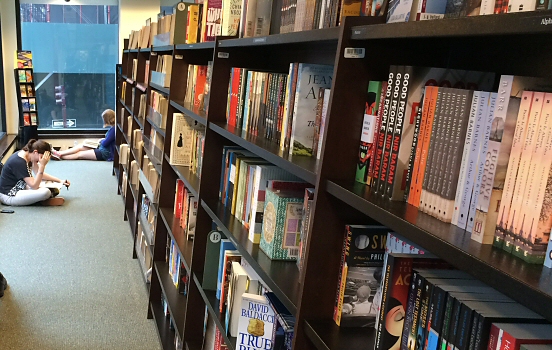 Reading at Barnes&Noble in New York.
When hurricane Katrina hit New Orleans in 2005, blog posts and Flickr photos from people on the ground found their way into CNN broadcasts and onto screens around the world. During the unrest following the Iranian elections in 2009, Twitter became an important channel for getting information beyond the usual barriers.
This is extraordinary stuff. It is also exhausting. Back in 2006, I wrote about Web 2.0 and social overload, a full year before I even had a Facebook profile. At the time, the idea of social overload still seemed vaguely theoretical. A few years later, hundreds of friends, relatives, colleagues and people you once met at a conference are broadcasting their victories, disasters, lunches, hangovers and relationship problems directly into your pocket.
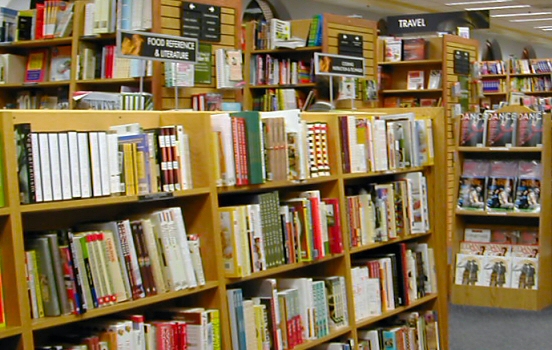 Old-school content at Borders in San Francisco.
Humanity has always kept diaries. We have been documenting our hopes, fears, desires and petty grievances ever since someone discovered that scratching symbols into something was cheaper than therapy. The difference is that the diary used to be hidden under the bed. Now it potentially has an audience of billions.
There was a time when people worried about personal privacy. Now we voluntarily tell enormous corporations where we are, what we are doing, who we are with and what we had for breakfast. Apparently Big Brother didn’t need to force us into surveillance after all. He just needed to give us a Like button.
All these connections are creating something resembling a gigantic nervous system. News, outrage, jokes, fear and enthusiasm move through it almost instantly, and the emotions of millions of strangers increasingly bleed into our own. And unlike that embarrassing diary under the bed, this stuff doesn’t necessarily disappear.
Google caches it. The Internet Archive preserves it. Servers somewhere quietly remember the version of you that you would very much prefer everyone else to forget. What will all that information eventually be used for? Nobody really knows. Comforting, isn’t it?
Of course, the same machinery has also given us something wonderful: the ability for gloriously stupid ideas to spread across the planet with breathtaking efficiency. Lolcats. Rickrolling. Matt Harding dancing badly around the world. Things that would have had virtually no chance of surviving the editorial machinery of traditional media can suddenly become global cultural artifacts.
And perhaps that is the real eye-opener. Not that we have too much information, but that we have lost the people who used to filter most of it for us. The old media decided what was worth printing. Editors filtered the noise before it reached your breakfast table. Today the gates are wide open, the guards have gone home, and several billion people are standing outside with megaphones.
The information is not going away. Quite the opposite. So the useful skill is no longer simply finding information. It is knowing what to ignore. Build better filters. Technical ones certainly, But mental ones too. Because the firehose is only getting bigger.
Related posts
Comments
No comments yet.
Leave a reply