Twenty years. Long enough for a generation to grow up knowing September 11 only as history. Long enough for wars to begin, drag on, and end badly. Long enough for airport security to become an elaborate ritual involving belts, shoes, liquids and the quiet surrender of dignity.
But not long enough to forget. On September 11 2001, the world watched New York burn.
It’s difficult now to remember just how different the world felt before that morning. The new millennium had arrived with a strange, almost naïve optimism. Both the Soviet Union and the Berlin Wall were gone. The Internet was going to connect humanity. Globalization was going to make everybody richer (or at least the ones with proper political connections). Naomi Klein’s No Logo was being passed around like contraband among people suspicious of exactly that idea. Protesters were smashing things at demonstrations against George W. Bush and global capitalism, while Britney Spears cheerfully occupied the charts. History, apparently, had other plans.
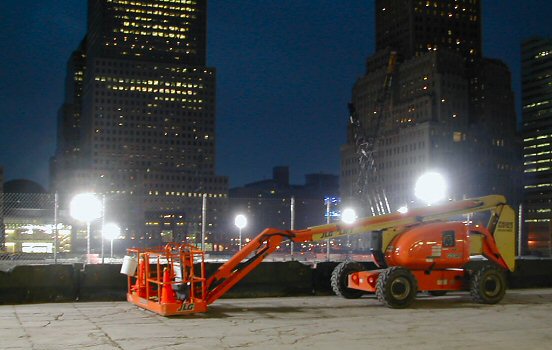 Ground Zero in New York 2002.
Then the planes hit. There are moments every generation carries around forever, little scars in the collective memory. Americans remembered where they were when Pearl Harbor was attacked or Kennedy was shot. In Sweden, an older generation remembers the night Olof Palme was murdered.
September 11 became one of those moments on a global scale. The difference was television. This time, much of the planet watched the disaster unfold live. The first tower burning. The second aircraft appearing in the frame. The realization that this wasn’t an accident. People jumping. The towers collapsing into Lower Manhattan in enormous clouds of dust. There was no comfortable distance between the event and the audience. History arrived live, unedited and without commercial breaks. The towers came down, but something else stayed in the air, a grief that never quite settled.
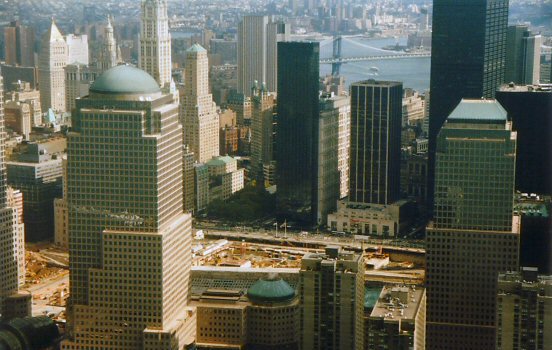 Ground Zero in New York 2002, as I saw it from a helicopter.
Five days later, I boarded a flight across Europe. Airport security was, understandably, a little tense. Actually, “tense” doesn’t quite cover it. The entire aviation industry seemed to have developed a nervous twitch overnight. Airports had suddenly become places where everybody watched everybody else, security personnel watched everybody twice, and the innocent act of carrying luggage had acquired vaguely criminal overtones. The world had changed in less than a week.
I visited New York the following year. Ground Zero was still a vast hole in Lower Manhattan. Seen from street level, it felt impossibly empty. A missing piece of the city surrounded by skyscrapers that suddenly seemed very fragile.
From a helicopter, the absence was even stranger. New York is one of the most aggressively vertical cities on Earth. Everything fights for space, attention and altitude. Yet there, in the middle of it all, was nothing. A bottomless-looking pit where two of the most recognizable buildings in the world had stood. An open wound surrounded by concrete, steel and millions of people getting on with their lives. New York gets knocked down, swears loudly, orders another coffee and goes back to work.
 Original placement of the twin towers.
Years later, I returned. The hole was gone. One World Trade Center now rises above Lower Manhattan, gleaming and improbably clean, a gigantic mirrored middle finger aimed at anyone who thought New York might stay down.
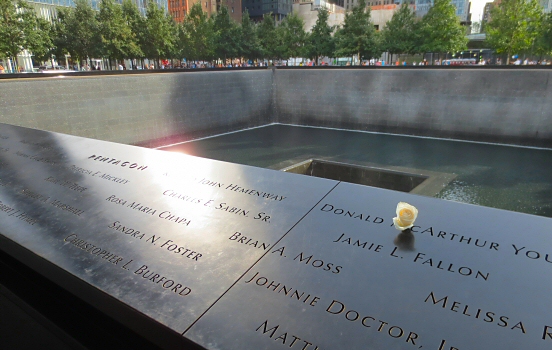
At street level, the footprints of the original Twin Towers have become enormous memorial pools. Water disappears continuously into dark square voids at their centers. Around them are the names of those who died. It is simple, elegant and deeply unsettling.
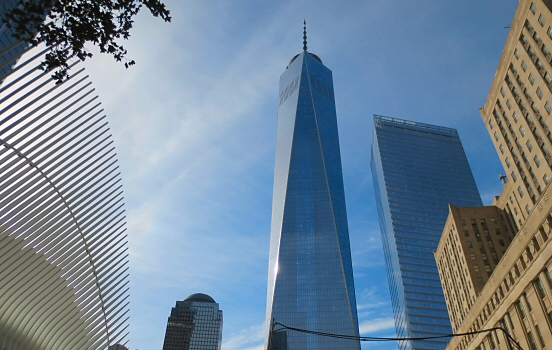 The new beacon of One World Trade Center.
Nearby, the 9/11 Memorial Museum preserves pieces of what happened: twisted steel, sections of the original foundations, damaged emergency vehicles and personal belongings recovered from the debris.
These aren’t grand historical abstractions. They are ordinary objects belonging to ordinary people who went to work one morning and never came home. That is what gets you. Not geopolitics. Not speeches. Not flags. A shoe. A wallet. A photograph.
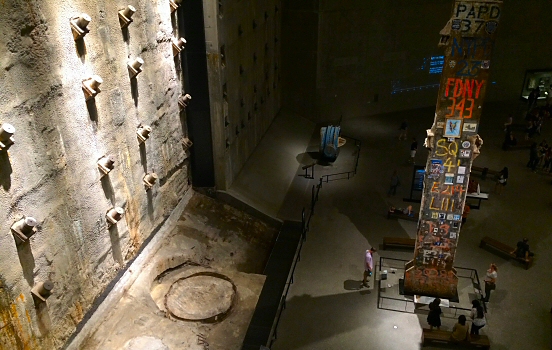 9/11 Memorial.
Twenty years later, New York has moved on, because New York always moves on. The skyline has healed as much as a skyline can. A new tower stands where smoke once rose, tourists take photographs, office workers hurry past and taxis continue their ancient tradition of attempting vehicular homicide.
Life continues. But look at the skyline long enough and you can still feel the absence. Two buildings are missing. And somehow, they always will be.
Related posts
Comments
No comments yet.
Leave a reply