There are artists whose work belongs inside spotless museums, guarded by polite security staff who become strangely nervous if you lean in too close. Then there’s Jaume Plensa.
The renowned Spanish artist has been active for decades, creating art in the public space. His sculptures have a habit of turning up where you least expect them. Outside office towers. In forgotten harbors. On windswept hillsides. Quiet giants sitting patiently while the rest of us rush to meetings, miss trains or argue about where to have lunch.
Sometimes I discover a sculpture while planning a trip. Other times I simply turn a corner and there it is, one of those familiar silent faces staring into the distance as if it has already figured everything out.
Wonderland + Alberta’s Dream (Calgary, 2012)
The 58-story skyscraper called The Bow dominates Calgary’s skyline like a giant slab of curved glass dropped onto the prairie. At its feet sits Wonderland, an enormous mesh head constructed from painted stainless steel. Standing there, surrounded by thousands of intersecting steel lines, the city suddenly feels distant and strangely quiet. Office workers hurry past without looking up, while tourists instinctively reach for their cameras. Everyone reacts differently, which is probably the whole point.
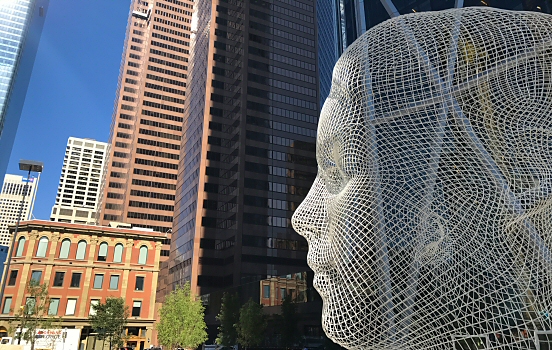 “Wonderland” by Jaume Plensa in Calgary.
Around the corner hides Alberta’s Dream, much smaller and easier to miss. Like many of Plensa’s works, it rewards anyone willing to slow down for a minute.
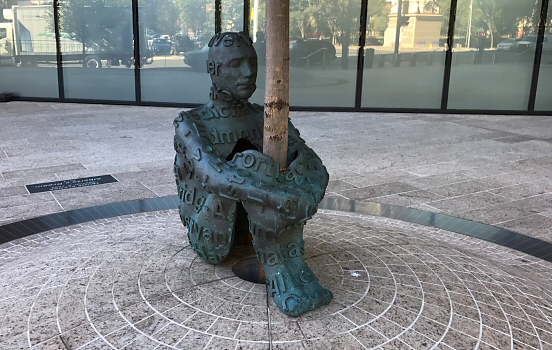 “Alberta’s Dream” by Jaume Plensa in Calgary.
Nomade (Antibes, 2010)
Perched on the old Bastion Saint-Jaume, Nomade spends its days gazing across the Mediterranean. The figure appears solid from afar, but up close it dissolves into a delicate lattice of stainless steel letters. Walk inside and the sea suddenly becomes part of the sculpture itself.
This harbor once watched Captain Cousteau’s famous ship Calypso sail into the unknown. The fortress Fort Carré can be seen a bit further north, once featured in the James Bond movie Never Say Never Again. Exploration seems to linger naturally in the air around here.
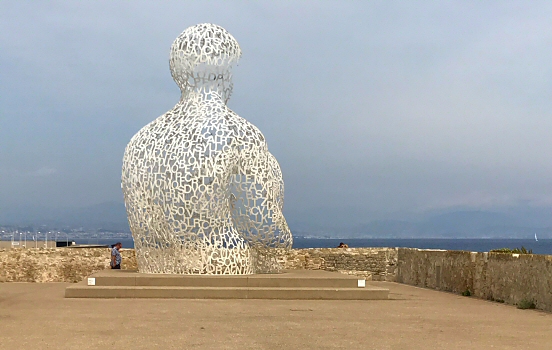 “Nomade” by Jaume Plensa in Antibes.
Sanna (Bordeaux, 2013)
If you’ve seen one of Plensa’s giant heads before, spotting another feels almost like running into an old friend. The one called Sanna sits opposite Bordeaux’s magnificent opera house on Place de la Comédie. The elegant eighteenth-century architecture competes with a bright crimson face that somehow manages to look both futuristic and timeless.
Set Poetes (Andorra la Vella, 2014)
People rarely visit Andorra for contemporary art. They’re usually here to ski, hike or buy tax-free electronics. Which makes it all the more surprising to find seven elegant human figures balanced high above Plaça Lídia Armengol. By day they silently observe the city below. At night they glow softly, transforming into watchful ghosts overlooking one of Europe’s smallest capitals.
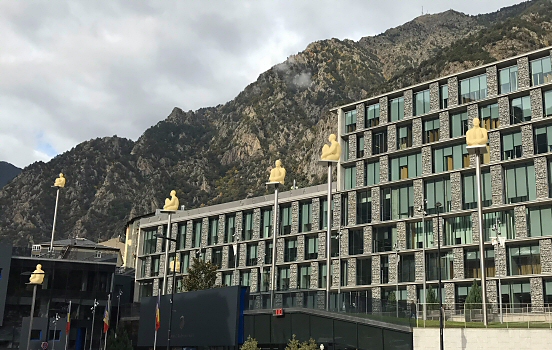 “Set Poetes” by Jaume Plensa in Andorra la Vella.
Dröm (Gothenburg, 2012)
Back home in Gothenburg, three familiar figures stand outside Clarion Hotel Post at Drottningtorget. It’s essentially the same idea as Set Poetes, only reduced from seven to three. I’ve walked past them countless times. Some days they disappear into the background. Other days, usually when the light is right and the square is unusually quiet, they remind me that even the daily commute deserves a little poetry.
Anna (Pilane, 2015)
Pilane Sculpture Park on island Tjörn already feels slightly unreal. Ancient Bronze Age graves spread across rolling hills while sheep wander freely between world-class sculptures. Then, rising from the landscape, comes Anna. Her oversized head quietly overlooks the Bohuslän countryside without demanding attention. The scale is monumental, yet the expression remains intimate, almost fragile.
On the drive there, don’t miss the Bronze Age rock carvings at nearby Basteröd. Humanity has apparently been leaving artwork in these hills for several thousand years. Plensa is simply the latest contributor.
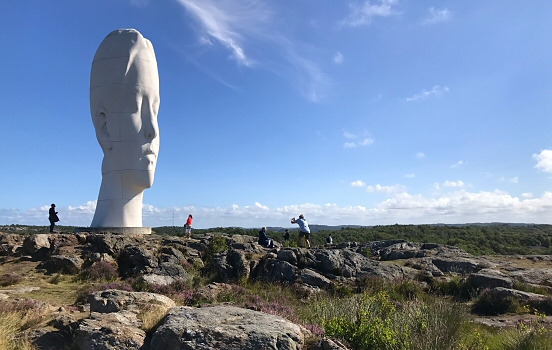 “Anna” by Jaume Plensa in Pilane.
Plensa’s sculptures now inhabit cities across the globe, quietly collecting stories from the people who pass them every day. I suspect I’ve only stumbled across a fraction of them. Which is good, it gives me another excuse to keep wandering.
For more information on all his works, the official site has a very good map.
Related posts
Comments
No comments yet.
Leave a reply