The web has come a long way since Tim Berners-Lee uploaded the first HTML page in 1991. Back then it was a collection of documents linked together by people who apparently believed that sharing information was a good idea.
After years of mostly static pages and one-way communication, something rather extraordinary happened. The audience stopped behaving like an audience. People started writing blogs, uploading films to YouTube, putting music on SoundCloud, sharing photographs, arguing with complete strangers on social networks and generally creating an enormous global mess of ideas, opinions, cat videos and occasionally something genuinely brilliant. We’re finally starting to see the benefits and possibilities of a distributed social web. And it all happened remarkably fast.
Ten years ago, most of this barely existed. Now anyone with an internet connection can publish something and potentially reach an audience on the other side of the planet before breakfast. No printing press. No television network. No record company. No editor in a badly fitted suit deciding whether you deserve to be heard. That is a fairly profound change.
The web has swallowed many of the platforms that came before it, such as radio, television, newspapers and telephone. Turned them into pieces of one enormous interconnected machine. At SXSW in Austin, Al Gore spoke about the enormous possibilities of the internet. For once, the grandiose language seems justified. We are still figuring out what this thing actually means.
Consider the device in your pocket. My first cellphone was roughly the size and weight of construction equipment and had one astonishing feature: it could make telephone calls. That was it. No camera. No GPS. No web browser. You called someone, assuming the battery survived long enough, and considered yourself a citizen of the future.
Today we casually carry devices with more computing power than the machines used during the Apollo moon missions. They are cameras, video recorders, music players, maps, compasses, GPS receivers, game consoles, libraries, newspapers and communication devices. A few decades ago this would have been science fiction. Now we complain if one takes three seconds to load a restaurant menu while standing on a moving train.
Even the mighty Encyclopaedia Britannica, sitting proudly and heavily on bookshelves since 1768, recently announced the end of its printed edition. Two and a half centuries of accumulated knowledge, replaced by something you can search while sitting on the toilet.
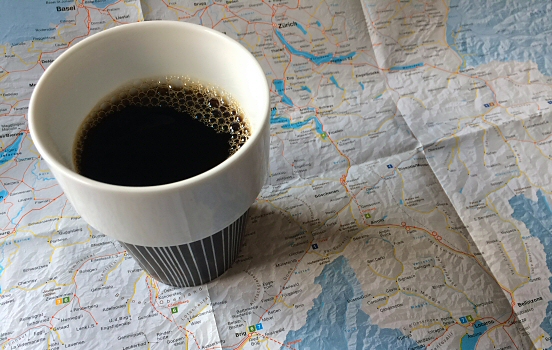 My traditional way of travel planning.
Travel has changed just as dramatically. I’ve always loved large paper maps. There is something wonderfully physical about spreading one across a table, putting down a cup of coffee and tracing roads through countries you haven’t visited yet. Maps invite wandering. You notice mountains, strange towns and roads leading somewhere you hadn’t intended to go.
But Google Maps and similar services have become indispensable. I use them all the time both when planning trips and while traveling. The entire geography of the planet now lives inside that same little device in my pocket.
There is, however, one slightly worrying direction in all this. Devices such as the iPad have shifted some of our attention from creating things to consuming them. They are beautiful machines for reading, watching, browsing and buying things, but less naturally suited to the messy business of actually making something. No proper keyboard, no mouse, less precision. The tools of creation polished away in favor of sitting comfortably on the sofa.
Perhaps that doesn’t matter. People will find other ways to create. They always have. Give humans a blank wall and eventually someone will paint on it. Give them a global network connecting billions of people and things get considerably more interesting.
The tools will change. The platforms will come and go. Some will disappear spectacularly after being purchased for several billion dollars by companies claiming this was all part of the strategy.
But the important part remains. For perhaps the first time in history, almost anyone can create something and share it instantly with almost everyone else. What we choose to do with that opportunity is another matter entirely.
Comments
No comments yet.
Leave a reply