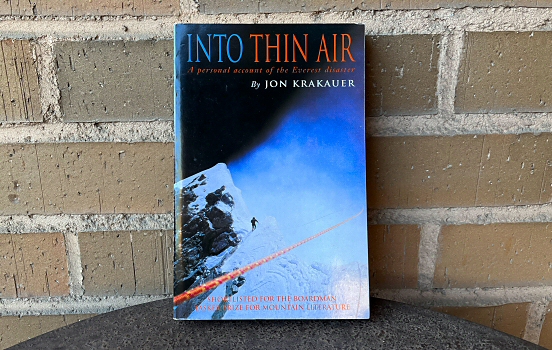
This is Jon Krakauer’s classic eyewitness account of the 1996 Mount Everest disaster. A story involving ambition, money, questionable judgment, catastrophic weather and the persistent human desire to stand on top of something simply because it’s there.
Most of the book takes place on Mount Everest, so this isn’t exactly a travel book in the traditional sense. There are no charming cafés, boutique hotels or helpful chapters about where to find the best food in Kathmandu. Krakauer does describe some trekking through Nepal, but eventually the traveling becomes decidedly vertical. And once you’re 8000 meters above sea level, I think you’ve earned the right to call it a journey.
The weather in May offers climbers a precious and notoriously brief window when Everest becomes slightly less interested in killing everyone who sets foot on it. Consequently, numerous expeditions were on the mountain at the same time.
Krakauer had joined Adventure Consultants, led by respected New Zealand guide Rob Hall. Nearby was Mountain Madness, headed by the charismatic American Scott Fischer. There was also David Breashears and his IMAX team, along with various other groups of people who had collectively decided that ordinary holidays lacked sufficient frostbite.
Krakauer had originally been sent by Outside magazine to write an article about the increasingly commercial business of climbing Everest. Instead, he found himself in the middle of one of mountaineering’s most infamous disasters.
As the teams pushed toward the summit, a violent storm swept across the mountain. Plans disintegrated. Climbers became lost, exhausted and trapped high above any place where human beings have much business being. By the time the storm passed, eight climbers were dead.
Everest, needless to say, is no picnic. Above roughly 26 000 feet lies the so-called “death zone”, where the human body begins losing an argument with biology. Experience helps. Expensive equipment helps. Supplemental oxygen certainly helps. None of them constitutes a guarantee. The mountain does not care how much you paid to be there. As one of many tragic testaments, the frozen corpse of Scott Fischer is still up there on the mountain ridge today, fifteen years later.
Among the climbers on Everest during those ill-fated days was Swedish adventurer Göran Kropp. Around the time I first read Into Thin Air, I also read 8000+, Kropp’s account of his own extraordinary expedition. In 1996, Kropp cycled from Stockholm to Everest Base Camp, then attempted to climb Everest without supplemental oxygen. Because apparently cycling halfway across the planet was merely the warm-up.
Krakauer describes how climbers including Rob Hall and Scott Fischer cheered Kropp during his struggle toward the summit. Kropp eventually succeeded, and since he was on Everest during the disaster, the events also appear in 8000+, giving another perspective on those terrible days.
Into Thin Air works because Krakauer doesn’t turn the story into a simple heroic adventure. It is messy, uncomfortable and filled with doubt, which is probably a more honest description of adventure than the glossy version usually sold to us. Mountains make excellent scenery, but they’re considerably less reliable as hosts.
If this sort of cheerful reading appeals to you, I can also recommend Joe Simpson’s Touching the Void, published in 1988. Another excellent mountaineering story in which things go spectacularly, horribly wrong.
Related posts
Comments
No comments yet.
Leave a reply