The web was built on a beautiful idea: information wants to be free. Unfortunately, some people interpreted that as your information wants to be theirs.
Recently, both Rick Strahl and Dave Shea discovered that other people had been helping themselves to their articles and republishing them elsewhere. Not quoting them. Not linking to them. Just taking the whole thing, putting it on another site and presumably waiting for applause, traffic and perhaps a small cheque from Google. This happens with depressing regularity.
Of course, the web complicates things. Everything is sitting there in plain sight, one right-click away from becoming somebody else’s “content”. And whenever the subject comes up, somebody inevitably offers the philosophical masterpiece: “If you don’t want people copying it, don’t put it on the Internet”. By that logic, leaving your bicycle outside means you’ve donated it to the community.
Another popular response is to regard plagiarism as flattery. This is presumably comforting right up until someone else starts making money from your work. Yes, material on the web is remarkably easy to copy, modify and redistribute. That doesn’t magically make it acceptable. Copyright doesn’t evaporate simply because something has been converted into HTML and exposed to broadband.
Quoting somebody is one thing. Borrowing a small part with proper attribution may be perfectly reasonable. Taking the whole thing and pretending it wandered onto your website by itself is something else entirely. And there is an astonishingly simple technology available for avoiding most unpleasantness: Ask. It works surprisingly well.
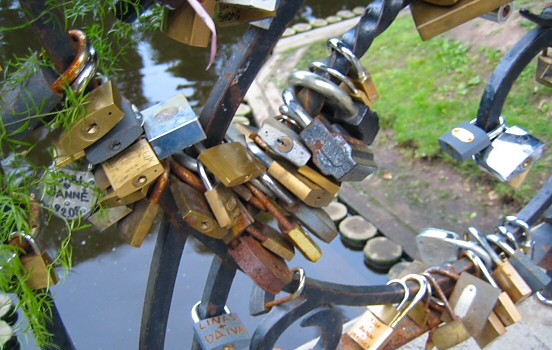 Lock it up. Padlocks on a bridge in Riga.
I’ve occasionally been contacted by people wanting to use something I created. One of my photographs, for example, ended up in a travel guide to Rome. The author contacted me first, politely asked for permission, and received it.
The bigger problem is that many people apparently never consider asking. Social networks and other proprietary platforms add another layer of murkiness, with terms of service granting the companies various rights to store, display and distribute whatever we enthusiastically shovel onto their servers. We still own our work, but we also tend to agree to rather generous licenses while clicking Accept with the attention span of a caffeinated ferret.
If you’re curious whether somebody has been borrowing your prose without the tedious formality of asking, services such as Copyscape can search the web for suspiciously familiar copies. Similar reverse-search tools exist for photographs. You may find nothing. Or you may discover that somewhere on some forgotten corner of the Internet, another person has decided that your work was simply too good not to become theirs. Flattery, apparently.
4 comments
Leave a reply