Kyoto isn’t Tokyo. It whispers softly and lures you in with the rustle of bamboo and the silence between footsteps. It doesn’t need to fight to get your attention, you will listen anyway.
I’ve been wandering alone through Kyoto. Drifting between temples, shrines and gardens. Just me, my thoughts and a city that seems perfectly content to let me disappear into it. At times, it feels like I’ve stumbled onto an abandoned Akira Kurosawa film set, minus the samurai and the inevitable bloodshed.
There’s something wonderfully disorienting about being a gaijin in Japan. A foreigner, an outsider, a walking question mark in a society governed by an elaborate collection of unspoken rules. Everyone else seems to know exactly what they’re doing, while I am struggling to decipher the simplest rituals, hoping my ignorance doesn’t accidentally cause an international incident.
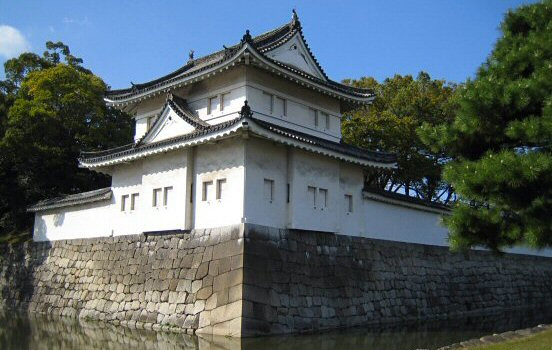 Exterior of Nijo-jo castle.
Naturally, being a hopeless film obsessive, I couldn’t resist following in the footsteps of Scarlett Johansson’s character in Lost In Translation. I even loaded up Air’s “Alone in Kyoto” on my iPod, providing my solitary pilgrimage with its own suitably melancholic soundtrack. Yes, it’s a painfully obvious cinematic cliché. Sue me. Sometimes reality deserves a decent soundtrack.
My movie-induced pilgrimage eventually brought me to Nijo-jo Castle, built in 1603 as the residence of Tokugawa Ieyasu, the first shogun of the Tokugawa dynasty. For anyone raised on the Shogun television series and a steady diet of Sonny Chiba ninja movies, this is practically sacred ground. Forget the usual tourist attractions. This is where history meets the glorious nonsense of childhood cinematic fantasies.
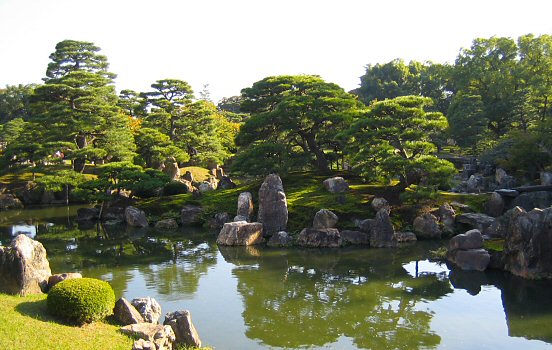 The garden of Nijo-jo castle.
The castle itself is an imposing affair, surrounded by massive stone walls and a moat, presumably designed to discourage uninvited guests with particularly sharp swords. Inside lies a rather ingenious security system: the famous “nightingale floors”. These wooden corridors produce a distinctive chirping sound whenever someone walks across them, supposedly warning the occupants of approaching assassins.
Naturally, I had to test the system. I attempted to sneak across the floor with all the stealth and cunning of a trained ninja. The floor squeaked loudly beneath every step. Apparently, my career as a silent assassin would have been spectacularly short.
But Kyoto isn’t really about playing ninja, however tempting that might be. Unlike the relentless urban machinery of Japan’s larger cities, Kyoto possesses an almost unsettling tranquility. Walking through the gardens and temple grounds, surrounded by carefully arranged stones, ancient wooden buildings, and trees that have probably witnessed more history than most European nations, I find myself slowing down. Thinking less about where I’m going and more about where I am.
It’s the sort of moment you wish you could preserve indefinitely. Bottle it, take it home and open it on some miserable Tuesday when life has resumed its usual parade of deadlines, obligations and assorted bullshit.
The Japanese have a concept called mono no aware, an awareness of the fleeting nature of things, and a quiet appreciation of their inevitable passing. It’s part of what makes the cherry blossoms so meaningful. Their beauty comes with an expiration date. They bloom, they dazzle, and then they’re gone.
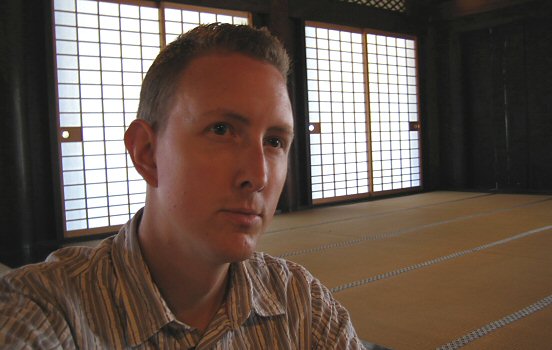 A moment of reflection in Nishi Hongan-ji temple.
I found an Internet café inside the train station to write this post, and suddenly back in familiar territories, the tranquil day already seems like a distant dream.
Being alone in Kyoto isn’t the same as being lonely. Far from it. Solitude, when chosen rather than inflicted, can be a magnificent thing. No audience, no expectations, no need to perform for anyone. Just a brief intermission between the louder, messier chapters of life.

3 comments
Leave a reply