Safari for Windows

Today was WWDC 2007 in San Francisco, with Steve Jobs doing what he does best: standing on a stage and making several thousand people believe that whatever Apple was about to sell them was not merely desirable, but somehow inevitable.

There was plenty of Leopard, the upcoming version of Mac OS X, and naturally the iPhone, due to arrive on June 29. Cool stuff, certainly, but hardly shocking. They even managed to squeeze in the obligatory Steve Ballmer bashing, because apparently no Apple keynote was complete without poking Microsoft with a stick.

Then came the genuinely interesting bit. Safari for Windows. Naturally, I downloaded it immediately to have a look. Unlike my colleague Roger, I had no trouble with the installation. Safari fired up without complaint and it was surprisingly fast.

Of course, Apple couldn’t resist bringing QuickTime along for the ride. Because apparently installing one Apple product without being introduced to several of its relatives would have been considered rude. And then there is the interface. People call it slick, stylish, elegant. To me, it looks vaguely like Netscape wandered into a bar sometime around 1998, drank heavily for nine years, and came out wearing brushed metal.

Admittedly, my eyes are conditioned by spending all day surrounded by Windows applications, and I have no particular affection for the Windows GUI either. But consistency matters. When an application runs on Windows, whether Apple likes it or not, it gets compared with everything else running on Windows. Safari doesn’t merely look different. It looks like a Mac application that has somehow taken a wrong turn and ended up on my PC.

The Safari team seems to have gone to extraordinary lengths to make the Windows version look and feel exactly like its Mac sibling. Even the typography whispers Mac. For a moment you can almost forget where you are. Then you hit Alt-Tab and reality returns.
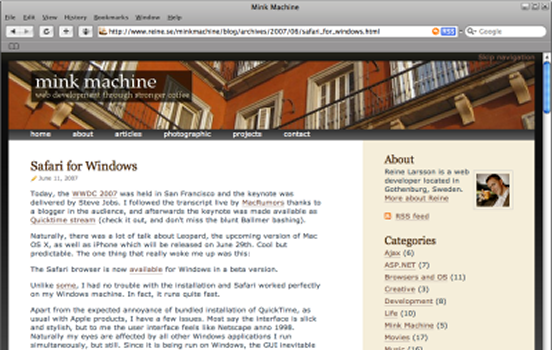
Safari screenshot Mink Machine rendered in Safari browser.

Underneath all that polished metal is the important part: Safari uses the same WebKit rendering engine as the Mac version. For web developers, that’s where things become genuinely useful.

Am I switching browsers? No. I’m not climbing over the garden fence into Apple’s carefully landscaped little kingdom anytime soon. But having Safari running natively on Windows means one more browser in which I can test front-end code without borrowing a Mac, begging a colleague, or sacrificing livestock to the browser compatibility gods.

And in 2007, when making a website behave consistently across browsers occasionally feels less like engineering and more like black magic, that’s reason enough to keep it around.

11 comments

  • avatar
    Mandus
    12 Jun, 2007
    Seems like you can download without getting QuickTime now. The GUI looks quite nice to me, perhaps a bit too much of a business look. But compared to other Vista programs it's a bit more sophisticated and sleek.
  • avatar
    12 Jun, 2007
    Thanks for the QT info! It's kind of strange that I react so strongly on the GUI, considering that Vista has stolen so many graphical elements from Mac OS. :)
  • avatar
    Mandus
    12 Jun, 2007
    Maybe, but I can see your point about it being a bit old fashioned. Anyway, a good thing is that you won't confuse it with IE or FF. :)
  • avatar
    13 Jun, 2007
    Hehe, that is true!
  • avatar
    Jonas Steverud
    13 Jun, 2007
    May whoever invented the brushed metal look always be reborn and never reach Nirvana! If it is something I hate about my Mac, then it is the metal look. Why they "ported" that to Windows in iTunes and now Safari is beyond me. Neither do I understand why they ported Safari to Windows? iTunes I can understand, as it is "bundled" with the iPod, but Safari? They will never make money on the browser so they have to cover the developing and maintenance costs in some other way - someone that has heard of a plausible theory? Are they counting on that most people only uses the web browser and hence is easier to lure into the Mac world if they can use the same browser after the switch?
  • avatar
    13 Jun, 2007
    Could it be Apple's way to get developers to create web applications for the iPhone? Not likely, since there is no way that Safari will have enough users when the iPhone is released. I would rather believe that Safari is part of Apple's longtime strategy to infiltrate the Windows platform. Both Parallels and Boot Camp are great tools for running Windows on a Mac and they will continue to persuade PC owners into making "the switch". Also, don't forget that they totally own the MP3 player market with iPod, which sort of requires iTunes, which may install bundled QuickTime, Safari and other stuff as well as silently setting default browser to Safari. Sneaky.
  • avatar
    Mandus
    13 Jun, 2007
    I think it's a matter of branding and getting more and increasing the casual Windows-users awareness of the Apple platform. Just as Reine said above, just wanted to reassure him that he got it right. :P
  • avatar
    Bollman
    16 Jun, 2007
    It's not far fetched to think that in some way, iPhone might require Safari. So far, it seems like iTunes will be needed to use the iPhone, there's also talk about it being a requirement to get a iTMS-account. No money will be made from iTunes or Safari on the windows platform. Of course, making the transition easy for "switchers" is one thing. Apple may also be heading in the way of a pure software company. It may not be too far off to see OSX run on any PC, it's only the EFI that keeps them apart now. It's also interesting t osee that Safari 3 still uses the "brushed metal"-look as it has been rumors about it being replaced for 10.5. //Bollman - installing OpenStep 4.2 in his Parallels Desktop :-D
  • avatar
    16 Jun, 2007
    Thanks for sharing! It seems that Safari is more than just required. In the keynote, Jobs mentioned that Safari is the application platform for the iPhone, so there won't be any need for learning yet another SDK. Instead it's up to the developers to create solid web sites using web standards. The touch screen will be an interesting interface to watch for accessibility issues.
  • avatar
    Bollman
    16 Jun, 2007
    Well, you're welcome! ;-) I'm not too impressed by the iPhone as of yet, we'll see when I've had the chance to try it out. Basing all third party applications on the webkit means that there will be less "hardcore" apps available. No TomTom and so on. Apple already offers something like that but based on google maps, online! Sure, it's cool but hardly useful when you're abroad. GPRS-data can be quite expensive and downloading large google-maps via GPRS won't be too fun either... I'm a little bit worried that when the iPhone actually hits the market it will have been surpassed by other phones. Maybe the interface weill be cool but locking in people to iTunes and Safari and not enabling the platform for third party applications like WM6 will be a big downside. The iPhone is also quite expensive which will be another minus. Sure, a lot of hardcore mac-users will buy it regardless and sure, some people with the urge to look cool will buy one. I recon you can get one cheap by the end of 2008 though as a lot of poeple will have lost interest ;-)
  • avatar
    17 Jun, 2007
    I'm also a bit concerned about the data transfer, both in terms of cost and availability. Since the iPhone has a wireless card in it, I suppose you could do some traditional leeching, but I hate the idea of searching for a hotspot just to check my cellphone calendar.

Leave a reply